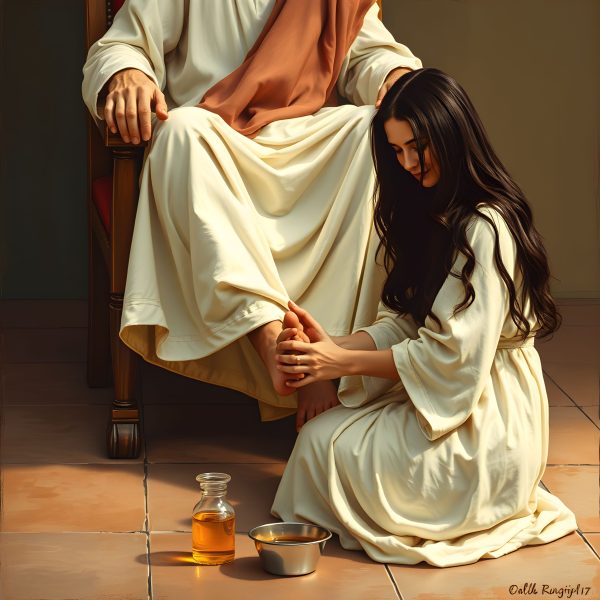
As Jesus and the disciples continued on their journey, they came to a village where a woman welcomed Jesus into her home. Her name was Martha and she had a sister named Mary. Mary sat down attentively before the Master, absorbing every revelation he shared. But Martha became exasperated with finishing the numerous household chores in preparation for her guests, so she interrupted Jesus and said, “Lord, don’t you think it’s unfair that my sister left me to do all the work by myself? You should tell her to get up and help me.” The Lord answered her, “Martha, my beloved Martha. Why are you upset and troubled, pulled away by all these many distractions? Mary has discovered the one thing most important by choosing to sit at my feet. She is undistracted, and I won’t take this privilege from her.” – Luke 10:38-42, TPT
I’ve always viewed this familiar passage as a case of “work vs. worship,” or “many things vs. one thing,” with worship, of course, being the “one thing.” I’ve soared high during seasons where I experienced Sovereign grace to spend much uninterrupted time at His feet, and I’ve desperately longed for those seasons to return when they shifted. And I must admit that I, like Martha, have asked for help with the earth stuff so that I once again had time to spend those long hours ministering to Him.
During one of these recent conversations with the Lord, I suddenly found myself in a heavenly counsel chamber. We were sitting around a rectangular wooden table, and before Him was a puzzle. The pieces were all in place, but like any completed puzzle, you could still see the lines where the pieces joined together. The Father smiled, waved His hand over the puzzle, and it became one complete, seamless picture.
Then He began to explain how the adversary had fragmented my life and focus by causing me to believe the lie that I was divided among many things. He invited me to return to the simplicity of only having one focus: Him, and only having one thing to do: obey Him. He said, Remember… you are guided by My eye (Psalm 32:8). So, your gaze is always and only to be upon Me. Then, when I look at something else, your eyes follow My gaze. In past seasons, your focus was not upon worship or encounter, it was upon Me, and I led you into worship and encounter. In this way, every season is the same. Focus upon Me every moment of every day, and I will lead you into worship, prayer, encounter, study, ministry, creativity, recreation, rest, or work. And remember… I worked, too…
I must work the works of Him who sent Me while it is day; the night is coming when no one can work. – John 9:4, NKJV
Avodah
Here we see from Yeshua’s example that work is not unspiritual. We also see that it must be done in its proper time. In the Hebrew language, the word “avodah” holds the meaning of both “work” and “worship”. And in Judaism, the concept of work as worship emphasizes that all actions, when performed with intention and dedication, can be considered sacred.
Brother Lawrence is the character in church history that embodies this timeless truth. He served as a lay brother in a Carmelite monastery in Paris during the 1600’s, where he spent his days either working in the kitchen or repairing sandals. During a time when the church was steeped in religion and works aimed at earning God’s approval, Brother Lawrence, by contrast, had a simple walk with God based solely on doing all things in love. Though, in the flesh, he hated kitchen work and was not very good at it, he learned that doing everything out of love for God transformed even the most mundane tasks into holy ecstasy. His goal for every moment of every day was to simply love God, without any thought of self, and to seek Him, without even seeking His gifts. He viewed doing even the most distasteful task as a way of loving God. Though he started out with the goal of punishing himself (in line with the religious philosophy of the day), he ended up experiencing wave after wave of indescribable bliss. He learned to abide in the Vine, by staying aware of his heart connection to God at all times. He said that at first, it took great effort to train his wandering mind and that he had to gently bring it back many times each day. But over time, his mind and heart learned to remain at home in the Father’s heart, no matter what he was doing or what was happening around him. His abiding and his joy were unshakeable. He, like Enoch, walked with God in Divine ecstasy.
Discerning The Times
Different things are important in different seasons. We already looked at John 9:4, where Jesus said that He was doing the work of the Father at exactly the right time, knowing that a “night” season would come when He would no longer do so. Could it be that this was one of the things Mary learned from Him as she sat at His feet that evening? Perhaps she watched His daily life, marveling at the continuous stream of Divine appointments and how He was always in the right place at the right time – yet was never rushed, hurried, overwhelmed or anxious. Perhaps, when He said, “I only do what I see My Father doing” (John 5:19 ), it ignited a passion in her to do the same…
Before Mary sat at His feet neglecting the tasks at hand, Jesus had already said that He would only be with them a little while longer (John 7:33). In this context, of course listening to His every word took precedence over things that could be done after He was gone. And in His final week, she again perceived that the end was near, so she anointed Him for burial.
Six days before the Passover began, Jesus went back to Bethany, the town where he raised Lazarus from the dead. They had prepared a supper for Jesus. Martha served, and Lazarus and Mary were among those at the table. Mary picked up an alabaster jar filled with nearly a liter of extremely rare and costly perfume—the purest extract of nard, and she anointed Jesus’ feet. Then she wiped them dry with her long hair. And the fragrance of the costly oil filled the house. But Judas the locksmith, Simon’s son, the betrayer, spoke up and said, “What a waste! We could have sold this perfume for a fortune and given the money to the poor!” (In fact, Judas had no heart for the poor. He only said this because he was a thief and in charge of the money case. He would steal money whenever he wanted from the funds given to support Jesus’ ministry.) Jesus said to Judas, “Leave her alone! She has saved it for the time of my burial. You’ll always have the poor with you; but you won’t always have me.” – John 12:1-8, TPT
Throughout the Gospels, Mary demonstrated that she was like the sons of Isachaar, whose understanding of the times enabled them to know exactly “what to do” (I Chronicles 12:32). She obviously listened with her heart and responded by doing the thing that pleased Yeshua most at that time in that situation. Her “one thing” was doing THE one thing that He desired when He desired it.
It is so simple even a child can do it. But living this way requires humility, surrender, and undivided heart, and absolute dependence upon the Spirit of Truth, allowing Him to “guide us into all truth.” Avoiding confusion, distraction, overwhelm, fragmentation and burnout is really all about keeping my heart and mind in a posture of love and absolute surrender, loving God with all my heart, soul and mind. It is about being led by His Spirit and not leaning on my own understanding, which will enable me to move with His times and seasons, always doing what I see the Father doing.. no more, no less.
Until next time,
Virginia